Tuesday, January 21, 2014

A month in India, part 7: Sholay 3D.

As luck would have it, on the last leg of my trip to India, I'd fall ill. Illness when traveling is an absolute curse - I was too nauseous to eat, to shop, to even move, and so I spent the last days of my time in India, in the gorgeous and interesting city of Madurai, cooped up in the hotel room, watching Koffee with Karan episodes and reading bad Indian English fiction (I'll have a post later on about the books I read in India).

A blessing in disguise was my 12 hour layover in the city of Mumbai. I hadn't seen a film in what felt like ages, since I hadn't really found any theaters during my time in Madurai, and thus I hadn't had the chance to catch Sholay's re-release in 3D. I'd read a bit about the legal weirdness surrounding the release, but in many ways I didn't really care - this was such an amazing opportunity to watch a favourite film of mine in a whole new way, I couldn't pass it up. 

So thanks to the help of an Indian friend with google fu and a patient taxi driver, I got to watch Sholay 3D at a comfortable multiplex in Juhu, Mumbai, in a surprisingly filled theater, considering it was an early Wednesday evening. And if my hasty movie snack of samosas and Pepsi wasn't good enough to begin with, this was an absolutely joyous film experience in every way.

The 3D release had added those gimmicky bits of things flying at the camera that send a jolt of surprise through each audience member. It was a funny collective experience. When Thakur shoots the cuffs off Jai and Veeru, the audience collectively gasped, then chuckled at our reactions. Silly 3D gimmicks, we knew the bullet wouldn't really fly at us. And yet, for a short moment, we did.

The picture looked crisp, but as ever, the real triumph of the film was not the picture quality, or even the sound mix (which had some things added, some things sharpened, but also made the soundtrack sound strange, almost like the vocals had been undercut in some way), but the story, the performances and the dialogues. The guys next to me were quoting lines about 5 seconds before spoken by the characters on the screen - at times, they'd misquote, and tut at themselves, when the line they thought they remembered was not precisely as they'd remembered it.

What I enjoyed perhaps most was the comedy, because Sholay is a very funny film, almost from top to bottom. From Asrani's goofy jailer, to Veeru's drunken antics, to the legendary scene between Jai and Mausi (one of Amitabh's best, understated comedic moments), I was laughing alongside the rest of the audience. Basanti also floored people, with her haan haan, maine kab mana kiya's. I speak of course as a huge fan of the movie, starting from the first time I ever saw it, but with this watch, there is no doubt in my mind why it's also such a classic movie - people love it to bits. They revel in every moment of the stupendously long running time. And to get to see this movie with such an appreciative audience, in such a crisp form - well, I can't say I've ever had such a memorable film experience. I was smiling throughout my arduous airport experience that came after the movie, simply remembering what an excellent experience I'd had.

And truly, what more could you possibly want out of a movie?

(Sidenote: in Chennai, I found coasters with Sholay quotes on them, but didn't buy them. "Yeh coffee mujhse dede Thakur!" still makes me chuckle, though.)

Monday, January 20, 2014

A month in India, part 6: Biriyani.


It's quite rare that a film that takes inspiration from another film actually references the film it was inspired by, so I was surprised to see Biriyani actually have its characters watch a few scenes of The Hangover, while at a party. Best friends Sugan (Karthi) and Parasuram (Premgi Amaren) wake up one morning, with a hangover, and only flashes of memories about the events that took place after they ran into a beautiful lady while getting late night biriyani. Turns out, during the course of the evening, they've become inadvertently involved in something big, and now they have to run from the authorities, all while trying to figure out precisely what happened during the evening, and who's at fault.

Of course, before any of this unfolds, we have to sit through scenes of their friendship and dynamic, in which Sugan is in incorrigible womanizing asshole, despite having a beautiful, sweet girlfriend in Priyanka (Hansika Motwani), who Parasuram also likes quite a bit. Parasuram is, in a word, a total loser, and Sugan is the go-getter, aided by his good looks and easy nature at every turn. They're not the most lovable bunch, and even though there is some comedy in their antics together, these are not characters you necessarily root for in such a way that when the plot turns serious and full of conspiracy theories, you actually care about what happens to them. Character development is slim.

The saving grace of the film is probably the catchy soundtrack - Ilayaraja's 200th, in fact. But otherwise, the list of flaws is a mile long, despite the fact that when I was watching, I wasn't too bothered by them. In retrospect, though, the film starts out merely okay and gets messier and messier towards the end. The final frame of the film makes absolutely no goddamn sense, even when I poked my movie companion and Twitter friend Bala, a native Tamizhan, to explain things to me.

Later on, during my brief time in Chennai, I enjoyed both an intense hangover and a meal of biriyani, and enjoyed the latter almost as much as I did not enjoy the former. All's well ends well, I suppose.

Sunday, January 19, 2014

A month in India, part 5: Aschorjo Prodip, or a Bengali Aladdin.

"Do you know the language?" a mature woman clad in a beautiful sari, sat next to me in the Ballygunge film theater, asked in polite English.

"No," I replied sheepishly. "We just wanted to see a Bengali film, my friend and I, and we thought this would be a good one."

Later on, I asked her, "Has it gotten good reviews?"

"Yes," she told me. "It is critically acclaimed."

I didn't tell her it was merely the quirky soundtrack and the worry over the other Bengali film in theaters being racist that lead us to watch Aschorjo Prodip (Astonishing lamp). Then there was the familiarity with the inspiration: we certainly knew the tale of Aladdin, so this modern take on the tale shouldn't be too hard to follow, even as we missed out on all the comedy of the dialogues and the subtleties of the story.

In fact, there seemed to be so much subtle humour to this film that I almost feel as if I shouldn't talk about it, having seen it without subtitles. The lead character, an unhappy middle-aged worker bee (Saswata Chatterjee, who played Bob Biswas in Kahaani) discovers a lamp and through the genie within it (played by Rajatabha Dutta), gains materialistic success - suddenly anything one could want in a consumerist society is at his finger tips. Yet, of course, the film is critical of this, but in ways that probably were more subtle than the mere visual storytelling let us know.

It also doesn't help that this main character, a victim of consumerist thinking, is not the most sympathetic. He seems hapless, with a dry sense of humour, but he's also got a pretty gross edge; the scenes with him lusting after a film starlet were none too fun to sit through. I just didn't find myself caring that much about what happened to this guy, whether his life would take a turn for the better or for worse. In fact, my mind would drift off and I'd shake myself out of thinking about Bengali food, and whether I should've had more momos as a snack prior to us watching the film.

With that said, it was interesting to watch this movie and then see the Kolkata around us - the Lion's Park next to Rabindra Sarovar, a lake-side park where a part of the ending was actually filmed. I suppose I'll have to rewatch this with subtitles to decide what my final take on it was. The quirky soundtrack was indeed quirky, but not very memorable, and almost a little too much, blasted through the speakers at full volume within the movie theater.

Saturday, January 18, 2014

A month in India, part 4: Dhoom 3 on Dhoom Day, Kolkata.


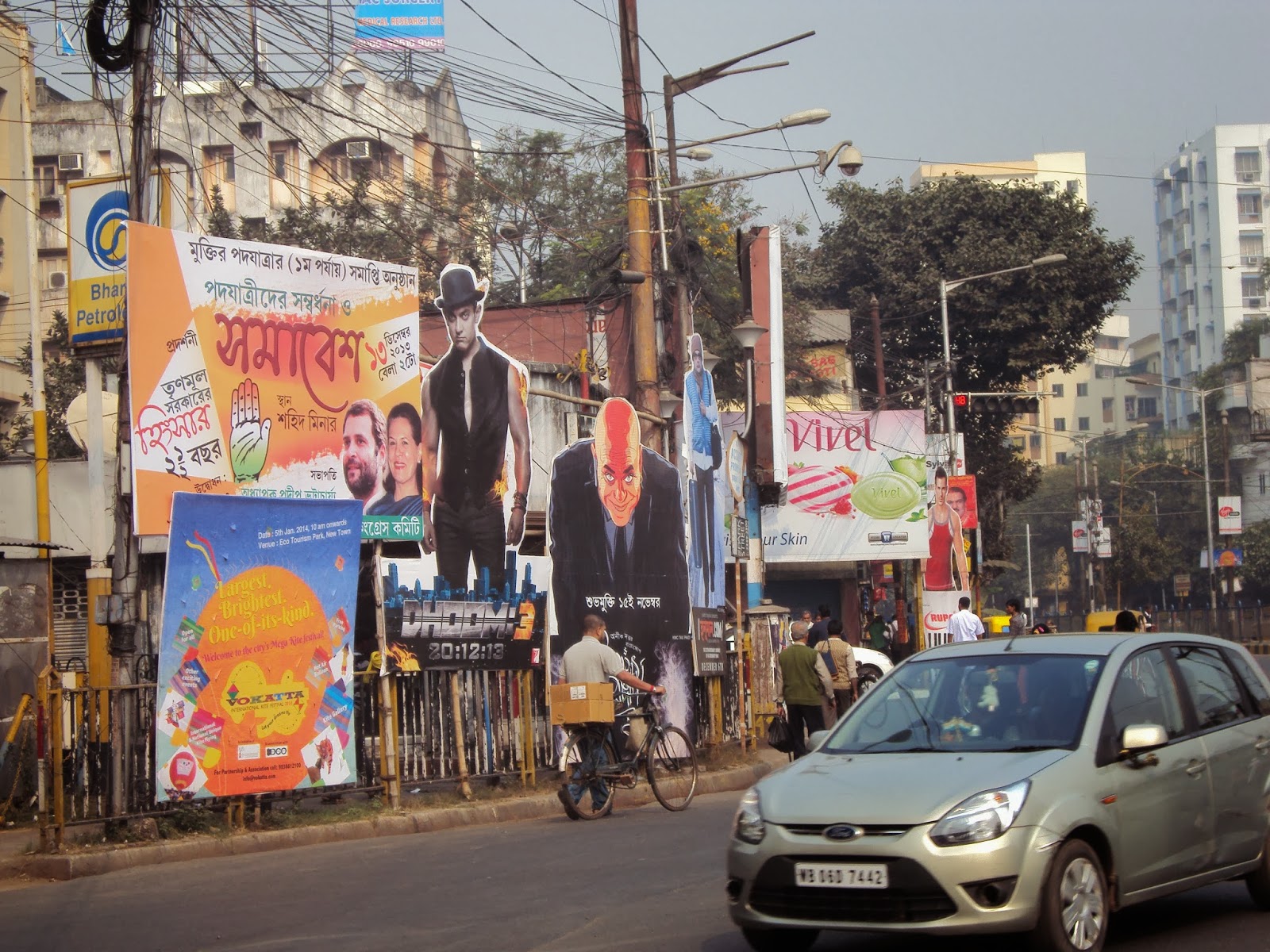
If Indian film promotion is a hurricane, then the first 10 days of our time in India were spent in the eye of the storm known as Dhoom 3. This was not a thing you could avoid, from Kolkata's metro platforms to the road crossing near our hotel, where a bowler hat-wearing Aamir Khan gazed over us. Promos on TV, posters on walls, advertisements on our morning papers - we saw it all.

And yet, we didn't mind one bit. This was the craze we'd signed up for - this was the movie that would be descending on India, and we knew precisely what we were in for. We smiled at every piece of gross, over-exposed piece of promotion we ran into, I worried over one restaurant supper whether we'd make it in time to catch Aamir's Koffee with Karan episode in the hotel room (which I got to watch and it was a blast). There probably should've been a moment where one went, "Okay, enough with this Dhoom 3 already!" and yet there kind of never was? We ate it up, eagerly.

In an ironic twist, perhaps, we watched the megalomaniac Bollywood big budget blockbuster in the city of art cinema, Kolkata, at a southern Kolkata multiplex called London Paris ("Just like home, eh?" I asked my Londoner friend). The tickets were the most expensive movie tickets we'd ever bought in India, 350 rupees each, but the seats reclined nicely, the atmosphere was excellent, and this was the opening Friday night, so one could expect to pay a premium (and compared to Finnish movie ticket prices, this was peanuts).


So what about the actual film itself? The glorious sequel to the maddest madcap action film series the world has ever seen? (And yes, the Fast and the Furious films are quite madcap as well, but they never had Vin Diesel dressing up as the Queen of England, so I think Dhoom still wins over its original inspiration.) Well, this was, in many ways, a very loyal sequel to the previous two. The villain still gets center stage, and any badassery and action sequences that Jai and Ali (Abhishek Bachchan and Uday Chopra, respectively) receive is almost like a pity hand-out, because it's not quite a Dhoom movie without them, and yet you get the sense that both of the sequels have kind of wished they could let these two characters go already. The women are still ludicrously under-written or just plain ludicrous, and mostly there to show off some skin, and dance in some songs. The action is reaching new heights, or new laws of physics.

And yet Dhoom 3 is different. It contains an emotional heart that doesn't quite sit with everything that's been wrapped around it - the formula, that is. It has a central performance that simultaneously makes you gasp in awe and then squirm in discomfort. It was a love story that is criminally (pun intended) underwritten and yet quite sweet. It falls somewhat short on the chemistry between Jai and the villain, which was largely the tentpole that held up the previous two films, but it's still good - replacing this is a chemistry between, well, two other leads.

The soundtrack is a winner from top to bottom, at least in my books. The tap dance spin on the Dhoom Machale number seems gimmicky but sounds and looks legitimately awesome, the circus picturization of Malang is just stunning, and Tu Hi Junoon is a winner all the way. Of course, my love for these songs is peppered by the nostalgia of hearing them during the trip, seeing all of those promos pop up here and there, plus the fact that these are absolutely amazing picturizations to be watched on the big screen.


Dhoom films will always defy logic and be considered as bad by some as they are considered amazing by others. As much as I try to rate these films in a sphere of their own, not to be compared or contrasted against any other films but each other, I can't help but feel that what I told my friend, walking to a Bengali restaurant after the movie, is very true: "This was the most amazing bad movie I have ever seen. Loved it. Will hear nothing bad against it." And yet something bad is precisely what I'm about to voice about it.

Even in the conventional masala madcap forgiveness, one has to forgive Dhoom 3 for a lot of things. Its attempts at being so so cool undercut its desire to be a legitimately good movie with an emotional core. The way it ignores Katrina Kaif's character for most of the movie, barely giving her any lines, barely ever giving her an actual characterisation, only hampers the story as a whole. While Ali's Mumbaiyya lines brought some people in the audience to tears with laughter, many others in the audience, including myself, remained stoic and didn't bite. As slick as it is, as wild as it is, as good (and as bad) as Aamir Khan's performance is, the fact remains it just isn't as good as it could be.

And yet, it's absolutely fantastic, without a doubt my favourite of the film series, and the sole Dhoom film I'll be glad to own on DVD. You should probably see it, for many a reason, and expect nothing, and expect everything, and know that when back in the day some of us theorised about what kind of a Dhoom film they'd have to make to convince Aamir Khan to join it, we didn't quite know it would be this epic a result.

Friday, January 17, 2014

A month in India, part 3: DDLJ at Maratha Mandir.

Watching one of my favourite films in the one theatre that had never stopped showing it seemed like a life goal I would in all likelihood never get to complete; fate would work its curious ways and me and my friend wouldn't find the theater, or go on the wrong day, or at the wrong time, or the showing would be sold out, or something would come between us and this piece of Indian film history. And yet, despite all my worries, things actually worked out. On an early December Monday afternoon, I sat down into a comfortable balcony seat, having paid the amazingly low price of 20 rupees, and got ready to watch Dilwale Dulhania Le Jayenge at the fabled Maratha Mandir, Mumbai, during the 947th week of its run.

Of course, before that, me and my friend walked half a kilometre in the wrong direction, then stood mistakenly in the Dhoom 3 advance booking line for about 10 minutes, were relentlessly stared at by the fellow matinee movie-goers, for our goriness and our femaleness, chatted to some young mothers who'd brought their kids to see the film, trundled into the movie theater (though not before I'd irritably told one dude a piece of my mind in Finnish) and were seated by an usher who ruled the balcony like a dictator (and later moved us, seemingly for no reason). Then we stood up and listened to the Indian national anthem, glancing in every direction to see of other people were actually singing it, but nobody seemed to, at least not loudly enough to note.

To me, this was a familiar movie - indeed, one of the most familiar ones. I couldn't quite quote it from memory, but the dialogues, the scenes, the characters, the songs were all ones I had watched a dozen times or more. This was a film that I had rewatched throughout the decade I've been exploring Indian cinema, each time learning something new, each time understanding the Hindi and the cultural references in it a bit better. There wasn't a way to watch it with new eyes, even in this amazing new context, the legendary Maratha Mandir.

And yet, it was a completely new experience. To watch it on my own and chuckle at Shahrukh's Raj, still my absolute favourite character that the man has ever played, is not quite the same as having a whole audience appreciate his silly witticisms on the first half, or the jokes on the second half. There were some surprising elements to the crowd's engagement with the movie, as well. The way that Anupam Kher's flirtatious storyline with one of Simran's aunts brought the whole house down was definitely a surprise to me. The last two songs descended on the audience like manna from the heavens. It was a good time, observing these reactions, sharing them and just appreciating getting this experience.

For the most part, though, this was the same movie I'd fallen in love with when seeing it for the first time, and the movie I still fiercely adored. I know it's not the perfect movie, and on an intellectual level I can completely understand all the various reasons why others find it over-rated or cheesy or just plain unlikable. And yet, myself, I can't see any of those things when I watch it. DDLJ is a favourite, in a way where it doesn't matter whether it's a classic or not, even though it's nice to have one's love for a film shared by others.

Even if you don't love DDLJ, if you are ever in Mumbai and have a free afternoon, make the journey to go see this film in this particular context. It's a beautiful, old theater, the tickets are very cheap, and it's an experience that is truly a must for any fan of Indian films.

Thursday, January 16, 2014

A month in India, part 2: R... Rajkumar.


Prabhudeva began his directorial career with the spry revitalisation of the Maine Pyar Kiya plot in the Telugu favourite Nuvvostenante Nenoddantana, and continued his directorial exploits in the South, before smashing onto the Hindi scene with Wanted, a Southie remake, but a badass one at that. I was a fan from the get-go, liking his visual, bombastic masala style, alongside the amazing choreography that his films always seemed to have. To pair him up with Shahid Kapoor, an excellent leg shaker in his own right, and add a bit of roughness to him in the action masala format - this all seemed like the recipe of a great movie.

R.. Rajkumar has a story that is almost so forgettable that I've actually forgotten the details, aside from the barebones plot structure - Shahid plays a hoodlum who joins forces with gratuitously shirtless villain Sonu Sood, mostly for monetary reasons. Things get tricky when Sonu Sood takes an interest in the daughter of the corrupt politician he's in cahoots with, who just happens to be the same girl (played by hapless, why-am-I-stuck-in-these-roles Sonakshi Sinha) Shahid's character has been relentlessly harassing for most of the movie. What's going to happen? Spoilers: the poster kind of says it all.

I suppose I should really thank the movie for spinning such a simplistic tale, as it made it very easy to follow with my beginner's Hindi skills in the cool southern Mumbai multiplex I saw this film at. Sonu Sood was great as ever, and the songs were the soundtrack to the rest of my trip, but the positives kind of run out there. What bothered me the most was the absolutely relentless, inexcusable sexual harassment by the main character, portrayed as romantic. You could say this has become an Indian film trope, and especially following the movement to make India safer for women, this trope has been called out - films may just be films, but the women on India's streets who suffer sexual harassment every day of their lives do know the effect that portraying this trope as romantic has on society. It's been a while since I've seen such a blatant example of "eve-teasing" disguised as a romantic subplot. There isn't even the slightest hint of Sonakshi's Chanda liking the main character, and he invades her personal space, doesn't take "no" for an answer, and it's just so, so off-putting.

It's also just completely unnecessary. Why can't she like this guy from the get go? Why can't they have meet-cute and then begin a bickering chemistry, which would largely serve the same function, but take away the icky issues with consent (she said no, so back off, buddy)? You could still have the songs, the arguments, even the slap scene that seems so pivotal, going by the times it's referenced back to.

I hate to turn my back on a guy I once listed as one of my top five directors, alongside such favourites as Manmohan Desai and Shankar, but I'm afraid it's come to this. I barely remember watching Rowdy Rathore, even though I know I did. This one didn't fare much better, though I still enjoy the soundtrack (and Ghandi baat is a song that will always be on my "India trip" playlist). If he insists on spicing his original films with these sorts of off-putting, regressive tropes, I'm just not interested - I like my action masala, but I also like a modicum of respect from the hero towards the heroine. This isn't a tall ask. It really isn't.

A month in India, part 1: Introduction.


I always knew India was a country one would enter and have all of their senses overwhelmed at once. Especially coming from a sparsely populated, cold northern country such as Finland, I was prepared for some sensory shock, a bit of culture shock and more. I also knew that even if there was a laundry list of inconveniences and things I couldn't wrap my head around about India, I'd probably fall in love. You can't spend a decade reading and learning and thinking about a country, and then visit and be completely disillusioned. It just doesn't happen. And thus, rather predictably, I did fall in love - with the overwhelming India, the actual India, at once so similar to the hundreds of filmed Indias I'd seen and yet completely different.

So understandably, India was a lot to take in, even for a fairly seasoned traveler such as myself. One acclimates, though, and during the month I spent there, urban India - be it Kolkata, Mumbai or Chennai - became a sphere I could actually navigate pretty successfully. For a while I could even imagine myself living there. As I went with a friend, who was a fellow Indian film fan, despite having grown distant from the films (due to lack of time and occasionally, lack of interest), we followed the path of our mutual interests; no stalking of film stars, but plenty of tracking down CD and DVD shops, seeing a film in each city we visited, sometimes two, and turning on the TV channel that played the latest hits when we went back to the hotel to relax. We also read a lot, ate a lot, walked a lot, saw sights - when you spend that long a time anywhere, there's no way your time is taken up by just one thing. But since this is a film blog, I'll focus on the films.

In the coming days I'll review the movies I saw there, and hopefully in the year that follows I'll get around to watching and discussing all the films I bought on DVD or VCD while in India. I say a year because I bought around 20 films and knowing myself, how bad I am at arranging time to watch anything, it'll probably take me a year. And maybe one day I'll actually get around to also doing my Filmi Year 2013 post.  Maybe.

Happy 2014, everybody!

Wednesday, November 13, 2013

A bit of self-reflection & Satyajit Ray's Devi.

Previously, when I have written about my ambivalence towards art house or parallel films in India (and elsewhere), I may have come down too hard on both myself as a viewer, who gets too easily bored and the stereotypical concept of these types of films as boring and incomprehensible. I think this kind of narrative is so tired and rather poisonous, and I'm kicking myself for ever furthering it on this blog. The fact is, most of my reactions to movies, such as Satyajit Ray's filmography, come down to two factors: my own bias against watching 'classics' just because they are considered by some as classics, and my lack of orientation towards watching these sorts of films. (And yes, this will be one of those slightly tiresome blog posts where I ponder why I react to things the way I do, as opposed to just telling you about my reactions. Apologies all around.)

I've always had this perhaps slightly ludicrous aversion to watching or reading anything that is a classic simply because it's received such a label. I don't believe in entertainment as education, unless there is a legitimate educational purpose to consuming a piece of entertainment (like the fact you're researching something, or a legitimate student of something, such as literature or art or film). I'll watch films considered classic, if and when I want to watch them - when I'm motivated to see what they're about, as opposed to composing a body of works as educational homework for myself. Some will tell you that you absolutely need to see certain films in order to discuss films at all, but I'm not really one of those people. I'll encourage curiosity in others, and in myself, because curiosity towards new things can only lead to great new discoveries and fun.

Some people obviously have a different take on this, and would probably argue that classics are considered classics because they are generally good and important works of art. I'm not denying any of this, as most of my favourite films could easily be considered classics in some form or another. It's just that this is my philosophy when it comes to art, and canonized art. We should recommend things to people because they might enjoy them, not because some sort of consensus has formed that something is important.

As far as my lack of orientation is concerned, that's where Devi and the previous Ray film I watched, Charulata, come in. They both seem to work in a format where themes and ideas slowly build up over the movie, only to reach a spectacular height of dramatic tension in the last ten or fifteen minutes of the film. This sort of cadence is not necessarily unique, but it differs from the films I typically watch. It's not that I don't enjoy it - it's just I'm not used to seeing it.

When I woke up on a Sunday morning and had this sudden idea of watching Devi alongside my many morning cups of coffee, I knew this was precisely why I had this philosophy about classics and art. As the mood struck me, the setting for the film was perfection - and the clear-headed, caffeinated emotional devastation that I felt at the end of the movie, was perfect, too. I watched the characters live in their world, commit their honest mistakes and become trapped in the societal conventions they couldn't struggle out of, because sometimes that is simply how things work.

Devi is, of course, a tale of a Bengali household where the father-in-law (Chhabi Biswas) of Dayamoyee (Sharmila Tagore) sees a premonition in a dream that Dayamoyee is a reincarnation of the goddess Kali. Umaprasad (Soumitra Chatterjee), her husband, is away completing his studies, and he returns to find his wife, living at the temple, worshipped as a goddess.

It's a concise film with excellent mood, tremendously interesting performances - particularly Sharmila - and beautiful cinematography, but I'm still far too focused on the ending, which is a complete punch to the gut, in a good way. It's satisfying in its tragedy, but if I'm completely honest with myself, the journey towards that ending was not as gripping as I might've hoped. What do I do with a film that I only really enjoyed during the last ten minutes? Rewatch it, I suppose, to take in all of those hints of what was coming, before I knew where it was all headed. Much as I did with Charulata, I certainly liked this film, but it didn't work its way into my heart as a favourite. And much as with Charulata, the review of the film turned out to be rather navel-gazing. Further apologies?

Sunday, October 20, 2013

Disappointments, small & large: Nautanki Saala & Shuddh Desi Romance.


The more films I watch, the more I begin to understand that while there are always plenty of discussions to be had about various aspects of films, the one thing you can't really debate is the viewer's connection to characters. At times films click and succeed in establishing that connection - sometimes it's writing, sometimes it's acting, quite often it's everything coming together beautifully to make you care for the characters, and what happens to them.

Nautanki Saala, a romantic comedy based on a French film Apres vous (adapted with permission, I think), is one of those films where I do like all of the characters but I'm not fully engaged with their journey. Ayushmann Khurana plays Ram, a theater director who saves the life of a layabout Mandar Lele (Kunal Roy Kapoor) and is thus responsible for his life. He hires Mandar and attempts to secretly get back Mandar's former love, Nandini (Pooja Salvi). Things get complicated when Ram falls for her instead.

There are numerous things to like about this film. For one, it's very funny - a particular scene at a restaurant had me laughing until I couldn't breathe, and all the actors do a good job of heightening the comedy. Secondly, the parallels between to Ramayana-inspired play and the actual events was pretty fun. I liked the principal cast, and the film was never boring or tedious. Yet, perhaps there was some tiny bit of chemistry missing in the love story, or maybe the complicated premise robbed that part of the film a bit of its romance, or maybe I was just in an odd mood that day. It's hard to tell sometimes. The bottom line is, I liked the movie, but not as much as I was hoping to. It's making me doubt my initial fondness for Ayushmann, to be perfectly honest - if I liked, but didn't love Vicky Donor, and now I'm getting largely the same reaction to his next movie, maybe he's not yet that good a performer. 


Shuddh Desi Romance delivers precisely nothing that the name implies, which I don't fault it for. I don't need my romances to be chaste, or particularly traditional. Sadly, what the film is also missing is good characterisation. It starts out fast, and introduces its main characters Raghuram (Sushant Singh Rajput) and Gayatri (Parineeti Chopra) quickly as well. They're on their way to a wedding - his - and she's one of the hired guests. He's having doubts, as the marriage is arranged, they talk on the bus, she smokes a cigarette, they kiss. Later, after he's escaped his wedding by literally running away, she seeks him out.

Things move so fast that by the time, about 30 minutes into the movie, when the couple is already running into their first signs of trouble, I began to wonder whether I cared all that much. I sort of knew them as characters, I suppose, but there was never enough establishing them, or their feelings for one another, as to help me have that connection that is so crucial in a film like this. Later this troubled twosome is joined by newcomer Vaani Kapoor's character Tara, seen earlier almost marrying Raghuram, and I had to ask myself, "What the hell is this movie trying to go for?".

Admittedly, it's not easy to write believable young people who are confused about what society wants out of them, and what they themselves want. But some of the vulnerabilities and complications in these characters seem so manufactured and nonsensical. They love each other but they don't want to commit, because one of them says that the other one could never commit seriously and the other one takes offence at that. It got to the point where I just felt all these arguments and endless rapidfire dialogues were pointless - if there were layers to be found, I couldn't make any sense of them. Was something just lost in translation? Or was I tuning out because I just didn't care?

I feel bad because this film got so many things right - I enjoy Parineeti Chopra's performances, and she had a relaxed chemistry with Sushant Singh Rajput. Vaani Kapoor was not bad for a debutante actress, and her smile gave a strong impression that her character was always two steps ahead of everybody else. (Interestingly enough, she'll be the lead in the Tamil/Telugu remake of Band Baaja Baarat, alongside Nani.) The music was cheery and quite fun. The cinematography was stunning, and made me want to visit Jaipur. But that connection, that investment to these characters and what happens to them, just wasn't there.

Tuesday, October 1, 2013

Barfi.

As much as we may all miss the UTV hand, the new opener of UTV movies, with the three dancers and the banging drums, remains an early promise of a quality picture - especially when it comes to good, interesting stories. This is also the case with Barfi, the tale of a death-mute man (played by Ranbir Kapoor) in Darjeeling and how his extraordinary character and joie de vivre impacts the lives of two women - Shruti (Ileana) who Barfi falls in love with, and Jhilmil (Priyanka Chopra), the autistic girl Barfi knows from childhood.

This was India's Foreign Oscar contender of last year, and thus I am rather late to view and review the film. I guess one thing that could be said of it was the mixed reaction - while people applauded the performances, there was some grumbling about "inspired" scenes, which is precisely the kind of thing that puts a damper on a movie such as this one. Barfi tries very hard to be heartfelt, a bit of a tear-jerker and generally moving. For the most part, I felt like it succeeded. The performances are good, and the characters do come alive. The light-hearted comedy, even though quite silly and physical at times, never feels as out of place as it could be - Barfi does a good job in being half this sort of magical realism with its silliness, but also being a grounded film. I liked the film, but I didn't love it - at no point was I moved as much as I think the film wanted me to be. It didn't quite stick with me, despite having such good intentions, and generally doing a good job of fulfilling my expectations.

I guess as ever when stars of Ranbir and Priyanka's calibre pick up really unusual or challenging roles for them, that's the main discussion point of the film. I've got nothing of substance to contribute there - I thought both did well, as expected, and probably served some award nods for their performances, but I just didn't feel that special connection to either character, or the story itself. So despite all its goodwill and good facets, in the end, Barfi was just an okay film for me.