Showing posts with label traveling to india. Show all posts

Thursday, January 23, 2014

A month in India, part 9: Film-related pictures.

A sign for film work in Mumbai.

Last frames of DDLJ at Maratha Mandir.

B or C movie theater in Mumbai. I think. 

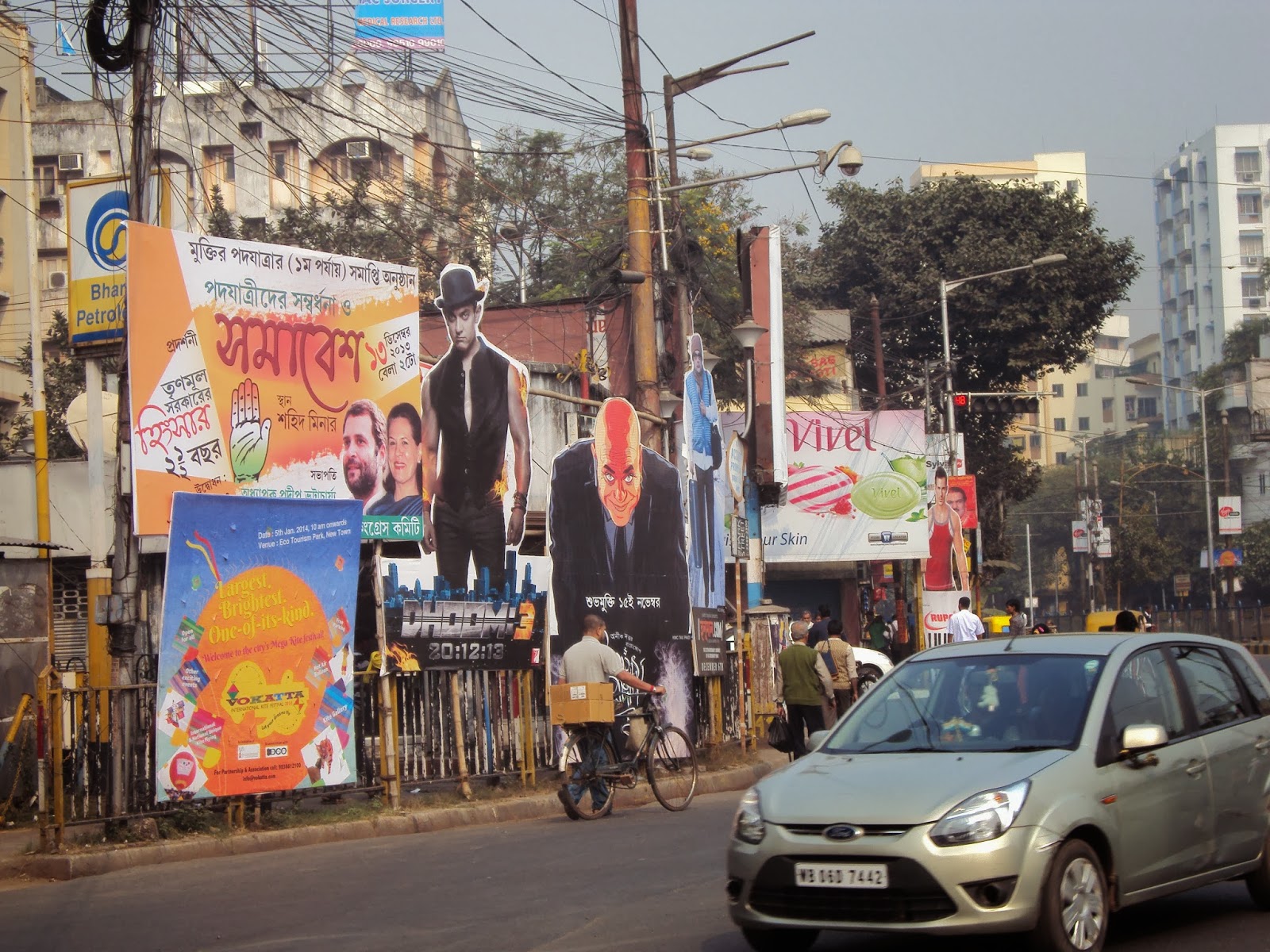
A common sight in India: political posters and film posters side-by-side.

Vijaykanth, a movie star-cum-politician welcoming people in the cheesiest poster I have ever seen.

...okay.

Vikram selling loans .. I think? This was the only ad with the man I ran into, so either he's not as popular as in my apartment, or he's discerning about advertisements.

Movie placards at the Bollywood disco section of the New Year's Eve party we went to in Chennai.

Movie posters in Madurai, including a re-release of an old MGR movie. His face you couldn't walk a mile in urban Tamil Nadu without seeing.

Wednesday, January 22, 2014

A month in India, part 8: Readings in fiction and non-fiction.

Battle for Bittora, The Zoya Factor, Those Pricey Thakur Girls by Anuja Chauhan 

Two of these books have had their film rights purchased by major Mumbai studios, Shahrukh's Red Chillies bought the Zoya Factor's rights and Battle for Bittora's rights were bought by Saregama. I'm sure that Thakur Girls will be made into a movie, too, if any studio is willing to tackle the 1980's Delhi milieu in a serious manner. It's hard to say whether any of these three frothy, enjoyable chicklit novels will make good movies, but what I do know is they make absolutely fantastic reading, and hence they top my list of recommendations.


Chauhan's writing is effortless and her characters, flawed and funny, jump off the page. Her heroines are just so likable, her heroes completely swoonworthy, and the way she masterfully weaves real life issues, be it communal troubles or corruption scandals, into her otherwise fluffy plots is really commendable. One of the covers for her novels featured the quote, "The only popular Indian fiction worth reading" and while I don't know much about Indian fiction as  a whole (only that it is a wonderful world I've not explored nearly enough, because it's not too available to those of us outside India), I have to encourage everybody with a hankering for a good, dreamy romance to seek Anuja Chauhan's books out.

Battle For Bittora was my first - scathing, clever political satire amidst absolutely adorable romance between two childhood sweethearts. If the combination sounds weird and unworkable, just trust me on this and check it out. The Zoya Factor is a tale of a young woman who inadvertently becomes the good luck charm of the Indian national cricket team, much to the team captain's chagrin. Those Pricey Thakur Girls portrays a dysfunctional family in India of Doordarshan and the pre-liberalised economy, and even though this too contains a fantastic romantic tale, what made me fall in love was the consistent portrayal of these very real-seeming characters, and the wide cast of them. Thakur Girls is getting a modern day sequel, taking a few of the characters and telling their story 15-20 years after the first novel took place, and I can't wait to read it.

Revolution 2020 by Chetan Bhagat

The author of the novels that 3 Idiots and Kai Po Che were based on suffers from a curious affliction - his best-selling novels aren't actually very good literary works, but get churned into pretty damn decent movies (okay, Hello aside). He portrays a modern India in very simplistic ways, but truthfully, in that "ripped from headlines" type of manner that a lot of things that are heavily inspired by reality can feel truthful.


Revolution 2020 I bought because I couldn't find an Anuja Chauhan novel to buy. It's a tale of three friends, two boys and a girl, their achievements, their lack of achievement, and the weird turns of life that drive them away and then drive them back together. The central schism of the novel is that Gopal, our narrator, is basically an immoral asshole, jealous to a flaw, morally corrupt and just unpleasant to read about. Our heroine and the girl he's madly in love with, Aarti, is portrayed merely through him, as the beautiful (oh and she is so beautiful!) mystery to him, because, as the character makes sure to emphasise so many times) girls are such confusing creatures! This type of gender essentialism and prejudice is precisely what turned me off the character, even before he turned into a wildly corrupt human being. The third friend, is a vaguely good human being, but again, through Gopal's lense, and Bhagat's lazy writing, we don't actually get to learn much about him, apart from a few disjointed characteristics.

Bhagat writes for an audience I'm probably not a part of; those who've learnt English as a second language and are only now easing into reading English. His English is simple and easy-to-read but absolutely lifeless as prose; the man used to be an investment banker, and indeed he writes like one who reads numbers all day, not poetry. He spells out how things are, rather than implying them through his narration of events. There are no hints or implications to be found or between-the-lines discoveries for the reader to make: everything is spelled out to a ridiculous degree. I have no doubt this novel will make a good film, at the hands of the right film maker, who can play with Gopal's immorality and give him shades to actually make the character interesting, and with the right cast, who can breathe life and subtleties into these stereotypical characters. I look forward to watching that movie, even as I won't be touching this book again.

The Krishna Key by Ashwin Sanghi

This was one of the novels I burned through when ill. I sort of resigned to my fate - I'd only found one book store in Madurai that sold any decent amount of English novels, and I needed something to read to kill time between the countless naps and Indian cable channels only increased my boredom, so reading was really the way to go. I knew this very Indian spin on the Da Vinci Code (oh, you couldn't tell?) would be trash, but I just needed something to read.

The backcover text actually makes this sound like quite a fun ride - a serial killer in the modern world thinks of himself as the last incarnation of Krishna. He starts killing the friends of a middle aged historian (who's got film star good looks, because the author is very obviously aiming for a film version of this starring one of the big Khans, or at least Hrithik or something), and implicating him in the murders. This launches a wild chase in which he tries to track down the "Krishna key" while being chased by the police, and the serial killer himself. However will this end?

As much as you could argue this is just fiction, there is something about the fervent way the author writes exposition into the mouth of his main character that makes me think he actually believes all this stuff. The conspiracy theories surrounding this one you might have heard - there is this theory going around, prodded up by certain political ideologies in India - that basically states everything and anything ever has its roots in Vedic Hindu culture, language and religion. Be it scientific discoveries, whole foreign languages or concepts, they all date back to this on starting point. Real life historians, linguists and archeologists probably regard these claims with the utmost skepticism but that doesn't stop the conspiracy theorists.

There are a few twists to keep the plot interesting but all in all, the whole thing falls apart when none of the characters are actually likable and all of their interactions are exposition of the conspiracy theories the author has read about on the web. The closer we got to the ending, the less I actually cared about what happened to these people.

The Cosmic Clues by Manjiri Prabhu

 This detective novel features a young woman who starts up her own detective agency, and unravels mysteries using her wit - and Hindu astrology. The admittedly silly idea would probably genuinely work, if the author would have learned that readers generally like to read about characters who aren't portrayed as flawless and perfect. Everybody in this book, from her continuously starstruck assistant, to the international criminal she tries to track down, seems so enamoured with the main character, I started to doubt her wonderfulness about 10 pages in. The problem is that nobody else does - she's smart, she's capable, she's witty and funny and charming and thus absolutely boring to read about. Her virtues are touted on every page, by every character, she's admired and fawned over, she figures everything out without any significant problems and has a persistently positive outlook on everything, from her home city of Pune to every damn food item she chows down. Every case she goes through in this book is solved without any major mishaps. Her family life is all good and nothing seems to trouble her for more than 2 seconds. 


And it is so goddamn annoying I almost couldn't finish this book, even though I eventually did, and rather liked the twist it took towards the end, which tied the book together quite well.

Apparently this too was bought by a film production company ..the one that made Marigold and Ragini MMS. Uhh. Well, if I can end my pessimist review on a positive note, I suppose I could say that these kinds of characterisations do actually work better in films - films can be exaggerated and silly, whereas I feel like books need characters to have edges and grit to them, in order to be interesting. Good luck?

Amar Akbar Anthony: Masala, Madness and Manmohan Desai by Sidharth Bhatia

 This was a slim non-fiction book about the mogul of madcap masala, Manmohan Desai, and more importantly his masterpiece film, Amar Akbar Anthony. It wasn't a very long read, but it was incredibly informative, detailing what made Desai such a unique film maker, and also what made his latter era films less stellar than his late 70's ones. It's an honest look at the man who made films for the common man, who knew his roots and lived by them, and all the logical considerations that went into piecing together this illogical masterpiece. For example, one thing I had no idea about was the fact that this film, Parvarish, Chacha Bhatija and Dharam-Veer were all filmed simultaneously. 1977 was an amazing year for Manmohan Desai, no doubt.


This was released in a book series detailing a bunch of other films as well. I didn't pick up any of the other ones, though now I wish I had - I would have loved to buy the sturdy paperback on Gangs of Wasseypur. 

Tuesday, January 21, 2014

A month in India, part 7: Sholay 3D.

As luck would have it, on the last leg of my trip to India, I'd fall ill. Illness when traveling is an absolute curse - I was too nauseous to eat, to shop, to even move, and so I spent the last days of my time in India, in the gorgeous and interesting city of Madurai, cooped up in the hotel room, watching Koffee with Karan episodes and reading bad Indian English fiction (I'll have a post later on about the books I read in India).

A blessing in disguise was my 12 hour layover in the city of Mumbai. I hadn't seen a film in what felt like ages, since I hadn't really found any theaters during my time in Madurai, and thus I hadn't had the chance to catch Sholay's re-release in 3D. I'd read a bit about the legal weirdness surrounding the release, but in many ways I didn't really care - this was such an amazing opportunity to watch a favourite film of mine in a whole new way, I couldn't pass it up. 

So thanks to the help of an Indian friend with google fu and a patient taxi driver, I got to watch Sholay 3D at a comfortable multiplex in Juhu, Mumbai, in a surprisingly filled theater, considering it was an early Wednesday evening. And if my hasty movie snack of samosas and Pepsi wasn't good enough to begin with, this was an absolutely joyous film experience in every way.

The 3D release had added those gimmicky bits of things flying at the camera that send a jolt of surprise through each audience member. It was a funny collective experience. When Thakur shoots the cuffs off Jai and Veeru, the audience collectively gasped, then chuckled at our reactions. Silly 3D gimmicks, we knew the bullet wouldn't really fly at us. And yet, for a short moment, we did.

The picture looked crisp, but as ever, the real triumph of the film was not the picture quality, or even the sound mix (which had some things added, some things sharpened, but also made the soundtrack sound strange, almost like the vocals had been undercut in some way), but the story, the performances and the dialogues. The guys next to me were quoting lines about 5 seconds before spoken by the characters on the screen - at times, they'd misquote, and tut at themselves, when the line they thought they remembered was not precisely as they'd remembered it.

What I enjoyed perhaps most was the comedy, because Sholay is a very funny film, almost from top to bottom. From Asrani's goofy jailer, to Veeru's drunken antics, to the legendary scene between Jai and Mausi (one of Amitabh's best, understated comedic moments), I was laughing alongside the rest of the audience. Basanti also floored people, with her haan haan, maine kab mana kiya's. I speak of course as a huge fan of the movie, starting from the first time I ever saw it, but with this watch, there is no doubt in my mind why it's also such a classic movie - people love it to bits. They revel in every moment of the stupendously long running time. And to get to see this movie with such an appreciative audience, in such a crisp form - well, I can't say I've ever had such a memorable film experience. I was smiling throughout my arduous airport experience that came after the movie, simply remembering what an excellent experience I'd had.

And truly, what more could you possibly want out of a movie?

(Sidenote: in Chennai, I found coasters with Sholay quotes on them, but didn't buy them. "Yeh coffee mujhse dede Thakur!" still makes me chuckle, though.)

Monday, January 20, 2014

A month in India, part 6: Biriyani.


It's quite rare that a film that takes inspiration from another film actually references the film it was inspired by, so I was surprised to see Biriyani actually have its characters watch a few scenes of The Hangover, while at a party. Best friends Sugan (Karthi) and Parasuram (Premgi Amaren) wake up one morning, with a hangover, and only flashes of memories about the events that took place after they ran into a beautiful lady while getting late night biriyani. Turns out, during the course of the evening, they've become inadvertently involved in something big, and now they have to run from the authorities, all while trying to figure out precisely what happened during the evening, and who's at fault.

Of course, before any of this unfolds, we have to sit through scenes of their friendship and dynamic, in which Sugan is in incorrigible womanizing asshole, despite having a beautiful, sweet girlfriend in Priyanka (Hansika Motwani), who Parasuram also likes quite a bit. Parasuram is, in a word, a total loser, and Sugan is the go-getter, aided by his good looks and easy nature at every turn. They're not the most lovable bunch, and even though there is some comedy in their antics together, these are not characters you necessarily root for in such a way that when the plot turns serious and full of conspiracy theories, you actually care about what happens to them. Character development is slim.

The saving grace of the film is probably the catchy soundtrack - Ilayaraja's 200th, in fact. But otherwise, the list of flaws is a mile long, despite the fact that when I was watching, I wasn't too bothered by them. In retrospect, though, the film starts out merely okay and gets messier and messier towards the end. The final frame of the film makes absolutely no goddamn sense, even when I poked my movie companion and Twitter friend Bala, a native Tamizhan, to explain things to me.

Later on, during my brief time in Chennai, I enjoyed both an intense hangover and a meal of biriyani, and enjoyed the latter almost as much as I did not enjoy the former. All's well ends well, I suppose.

Saturday, January 18, 2014

A month in India, part 4: Dhoom 3 on Dhoom Day, Kolkata.


If Indian film promotion is a hurricane, then the first 10 days of our time in India were spent in the eye of the storm known as Dhoom 3. This was not a thing you could avoid, from Kolkata's metro platforms to the road crossing near our hotel, where a bowler hat-wearing Aamir Khan gazed over us. Promos on TV, posters on walls, advertisements on our morning papers - we saw it all.

And yet, we didn't mind one bit. This was the craze we'd signed up for - this was the movie that would be descending on India, and we knew precisely what we were in for. We smiled at every piece of gross, over-exposed piece of promotion we ran into, I worried over one restaurant supper whether we'd make it in time to catch Aamir's Koffee with Karan episode in the hotel room (which I got to watch and it was a blast). There probably should've been a moment where one went, "Okay, enough with this Dhoom 3 already!" and yet there kind of never was? We ate it up, eagerly.

In an ironic twist, perhaps, we watched the megalomaniac Bollywood big budget blockbuster in the city of art cinema, Kolkata, at a southern Kolkata multiplex called London Paris ("Just like home, eh?" I asked my Londoner friend). The tickets were the most expensive movie tickets we'd ever bought in India, 350 rupees each, but the seats reclined nicely, the atmosphere was excellent, and this was the opening Friday night, so one could expect to pay a premium (and compared to Finnish movie ticket prices, this was peanuts).


So what about the actual film itself? The glorious sequel to the maddest madcap action film series the world has ever seen? (And yes, the Fast and the Furious films are quite madcap as well, but they never had Vin Diesel dressing up as the Queen of England, so I think Dhoom still wins over its original inspiration.) Well, this was, in many ways, a very loyal sequel to the previous two. The villain still gets center stage, and any badassery and action sequences that Jai and Ali (Abhishek Bachchan and Uday Chopra, respectively) receive is almost like a pity hand-out, because it's not quite a Dhoom movie without them, and yet you get the sense that both of the sequels have kind of wished they could let these two characters go already. The women are still ludicrously under-written or just plain ludicrous, and mostly there to show off some skin, and dance in some songs. The action is reaching new heights, or new laws of physics.

And yet Dhoom 3 is different. It contains an emotional heart that doesn't quite sit with everything that's been wrapped around it - the formula, that is. It has a central performance that simultaneously makes you gasp in awe and then squirm in discomfort. It was a love story that is criminally (pun intended) underwritten and yet quite sweet. It falls somewhat short on the chemistry between Jai and the villain, which was largely the tentpole that held up the previous two films, but it's still good - replacing this is a chemistry between, well, two other leads.

The soundtrack is a winner from top to bottom, at least in my books. The tap dance spin on the Dhoom Machale number seems gimmicky but sounds and looks legitimately awesome, the circus picturization of Malang is just stunning, and Tu Hi Junoon is a winner all the way. Of course, my love for these songs is peppered by the nostalgia of hearing them during the trip, seeing all of those promos pop up here and there, plus the fact that these are absolutely amazing picturizations to be watched on the big screen.


Dhoom films will always defy logic and be considered as bad by some as they are considered amazing by others. As much as I try to rate these films in a sphere of their own, not to be compared or contrasted against any other films but each other, I can't help but feel that what I told my friend, walking to a Bengali restaurant after the movie, is very true: "This was the most amazing bad movie I have ever seen. Loved it. Will hear nothing bad against it." And yet something bad is precisely what I'm about to voice about it.

Even in the conventional masala madcap forgiveness, one has to forgive Dhoom 3 for a lot of things. Its attempts at being so so cool undercut its desire to be a legitimately good movie with an emotional core. The way it ignores Katrina Kaif's character for most of the movie, barely giving her any lines, barely ever giving her an actual characterisation, only hampers the story as a whole. While Ali's Mumbaiyya lines brought some people in the audience to tears with laughter, many others in the audience, including myself, remained stoic and didn't bite. As slick as it is, as wild as it is, as good (and as bad) as Aamir Khan's performance is, the fact remains it just isn't as good as it could be.

And yet, it's absolutely fantastic, without a doubt my favourite of the film series, and the sole Dhoom film I'll be glad to own on DVD. You should probably see it, for many a reason, and expect nothing, and expect everything, and know that when back in the day some of us theorised about what kind of a Dhoom film they'd have to make to convince Aamir Khan to join it, we didn't quite know it would be this epic a result.

Friday, January 17, 2014

A month in India, part 3: DDLJ at Maratha Mandir.

Watching one of my favourite films in the one theatre that had never stopped showing it seemed like a life goal I would in all likelihood never get to complete; fate would work its curious ways and me and my friend wouldn't find the theater, or go on the wrong day, or at the wrong time, or the showing would be sold out, or something would come between us and this piece of Indian film history. And yet, despite all my worries, things actually worked out. On an early December Monday afternoon, I sat down into a comfortable balcony seat, having paid the amazingly low price of 20 rupees, and got ready to watch Dilwale Dulhania Le Jayenge at the fabled Maratha Mandir, Mumbai, during the 947th week of its run.

Of course, before that, me and my friend walked half a kilometre in the wrong direction, then stood mistakenly in the Dhoom 3 advance booking line for about 10 minutes, were relentlessly stared at by the fellow matinee movie-goers, for our goriness and our femaleness, chatted to some young mothers who'd brought their kids to see the film, trundled into the movie theater (though not before I'd irritably told one dude a piece of my mind in Finnish) and were seated by an usher who ruled the balcony like a dictator (and later moved us, seemingly for no reason). Then we stood up and listened to the Indian national anthem, glancing in every direction to see of other people were actually singing it, but nobody seemed to, at least not loudly enough to note.

To me, this was a familiar movie - indeed, one of the most familiar ones. I couldn't quite quote it from memory, but the dialogues, the scenes, the characters, the songs were all ones I had watched a dozen times or more. This was a film that I had rewatched throughout the decade I've been exploring Indian cinema, each time learning something new, each time understanding the Hindi and the cultural references in it a bit better. There wasn't a way to watch it with new eyes, even in this amazing new context, the legendary Maratha Mandir.

And yet, it was a completely new experience. To watch it on my own and chuckle at Shahrukh's Raj, still my absolute favourite character that the man has ever played, is not quite the same as having a whole audience appreciate his silly witticisms on the first half, or the jokes on the second half. There were some surprising elements to the crowd's engagement with the movie, as well. The way that Anupam Kher's flirtatious storyline with one of Simran's aunts brought the whole house down was definitely a surprise to me. The last two songs descended on the audience like manna from the heavens. It was a good time, observing these reactions, sharing them and just appreciating getting this experience.

For the most part, though, this was the same movie I'd fallen in love with when seeing it for the first time, and the movie I still fiercely adored. I know it's not the perfect movie, and on an intellectual level I can completely understand all the various reasons why others find it over-rated or cheesy or just plain unlikable. And yet, myself, I can't see any of those things when I watch it. DDLJ is a favourite, in a way where it doesn't matter whether it's a classic or not, even though it's nice to have one's love for a film shared by others.

Even if you don't love DDLJ, if you are ever in Mumbai and have a free afternoon, make the journey to go see this film in this particular context. It's a beautiful, old theater, the tickets are very cheap, and it's an experience that is truly a must for any fan of Indian films.

Thursday, January 16, 2014

A month in India, part 1: Introduction.


I always knew India was a country one would enter and have all of their senses overwhelmed at once. Especially coming from a sparsely populated, cold northern country such as Finland, I was prepared for some sensory shock, a bit of culture shock and more. I also knew that even if there was a laundry list of inconveniences and things I couldn't wrap my head around about India, I'd probably fall in love. You can't spend a decade reading and learning and thinking about a country, and then visit and be completely disillusioned. It just doesn't happen. And thus, rather predictably, I did fall in love - with the overwhelming India, the actual India, at once so similar to the hundreds of filmed Indias I'd seen and yet completely different.

So understandably, India was a lot to take in, even for a fairly seasoned traveler such as myself. One acclimates, though, and during the month I spent there, urban India - be it Kolkata, Mumbai or Chennai - became a sphere I could actually navigate pretty successfully. For a while I could even imagine myself living there. As I went with a friend, who was a fellow Indian film fan, despite having grown distant from the films (due to lack of time and occasionally, lack of interest), we followed the path of our mutual interests; no stalking of film stars, but plenty of tracking down CD and DVD shops, seeing a film in each city we visited, sometimes two, and turning on the TV channel that played the latest hits when we went back to the hotel to relax. We also read a lot, ate a lot, walked a lot, saw sights - when you spend that long a time anywhere, there's no way your time is taken up by just one thing. But since this is a film blog, I'll focus on the films.

In the coming days I'll review the movies I saw there, and hopefully in the year that follows I'll get around to watching and discussing all the films I bought on DVD or VCD while in India. I say a year because I bought around 20 films and knowing myself, how bad I am at arranging time to watch anything, it'll probably take me a year. And maybe one day I'll actually get around to also doing my Filmi Year 2013 post.  Maybe.

Happy 2014, everybody!

Saturday, August 10, 2013

A decade in a life, and in film.


There is something poetic about the fact that while Indian cinema celebrates 100 years of existence, this year I can celebrate the tenth year anniversary of watching my first Bollywood film. If you don't know the story of the how that happened, you can read all about here. I didn't follow Indian films actively right away, obviously - I stumbled around, finding films I thought I might like, and ones I thought I ought to watch. It was only two years later, in 2005, that I actually began watching films on a less sporadic, accidental basis. I began to really get to know the stars, and look beyond the clichés. I began hanging out on Bollywood forums and websites (well, mainly the BollyWHAT? ones) and I made a friend in my city, who let me borrow a bunch of films and introduced me to so many new things, be it older Hindi cinema or the wonderful worlds of Southie cinema.

In 2007 I was already somewhat of a veteran, in that I knew what I liked, what I didn't like and what I wanted to see more of, and started this blog to showcase my fascination to the world. Ever since then, it's been my own personal opinion repository, one I sometimes maintain with extreme regularity and passion and that I sometimes let fall to the wayside in a rather regrettable manner. My love for Indian cinema remains ever-present but fluctuates - one month I'm watching three films in an evening, the next I haven't watched a single film, or even rewatched an old favourite.


The love has never gone away, though, and Indian films is the one fandom I think I'll always come back to. Therefore it's probably odd to most people that in my time watching these films, in all my time taking in their sounds and sights and cultural ideas, I've never actually been to India.

And unlike for most people, I can't even claim that it's been an issue of time or money. I've had enough time and money to travel to other far away corners of the world - I've been to the US, twice, South Korea, twice and I've even swung by the United Kingdom enough times to make up the money for a plane ticket to India. But travel is an odd beast, and my problem with India has been that I haven't wanted to go alone, nor has traveling alone to India been recommended to me.

Weirdly enough, even as I've expanded my horizons and gained more in-depth knowledge about Indian society, politics, history and culture as a whole, what eventually made me finally go to India was film-related. I was exchanging emails with a long-time friend who I'd initially met online but eventually got to know face-to-face as well, when visiting her country. She was also a fan of Indian films, so I wrote to her about how much I was looking forward to what is surely the most curious casting in the most bombastic film saga of recent memory, Aamir Khan in Dhoom 3. Jokingly I asked her, "You wouldn't want to swing by India at the end of this year?" and to my great surprise, she replied she'd love to visit India (a second visit for her). So we began talking, and then we began planning, and now we're booking.


Are your eye-brows raised? "Did she just write she's going to India to see Dhoom 3, out of all the movies in all the years, Dhoom goddamn 3?" No, that's not it. It's more one of those wonderful things where circumstances just come together and collide to create a new thing. My former music teacher probably shows Bollywood to her students on a yearly basis. It just happened so that I was the only one in that class receptive to Hindi cinema's charms, and wanted to see more. Similarly, I've wanted to go to India for over 10 years now, but have never had a friend to go with, and then suddenly I realise there is a friend who is not only willing to go, but is happy to go see Dhoom 3 and embraces the idea (and whose tastes in film tend to line up with mine), and the release of Dhoom 3 happens to coincide with a decent time to go travel in India (not too hot, not too damp) and when it's convenient for us two Westerners to go, as it's Christmas holidays.

So you see, Dhoom 3 just happens to be at the intersection of all these good things. I don't expect worlds out of it, as a movie - it's just a movie, starring some people I like, and it's a movie I'd probably see regardless of the circumstances. The fact that circumstances just happened to fall together, after my joking question, was kind of perfect. I'll be the first one to tell you that Indian culture, or cultures, are rich beyond belief and to only watch the films would be missing out on the various aspects, both positive and negative, of an interesting nation and its people. At the same, I'd be lying if I didn't admit that the films form the backbone of my personal attachment and interest in India. Thus it feels fitting that I'll be heading to India with somebody that I don't have to drag into cinemas against their will, and instead can go see films with, and visit all the historical, cultural and just plain interesting sights as well.

I'm so happy to be going to India, because it feels like a long overdue visit, and I'm even happier that it feels like I'm going to appreciate it a lot more, now that I've done my share of reading and studying India, and the fact that I'm going with somebody I like, and who I know is interested in similar things as I am. It also feels very fitting, that I'm going near the anniversary of when I first got into Indian films - almost as if it was always meant to be.